

Acoustic fence installation guide
NoiseBloc® goes up with standard fencing skills and tools. This guide covers preparation, the build sequence for each system and the checks that keep the barrier performing as tested.
Or call 01264 366211, Monday to Friday
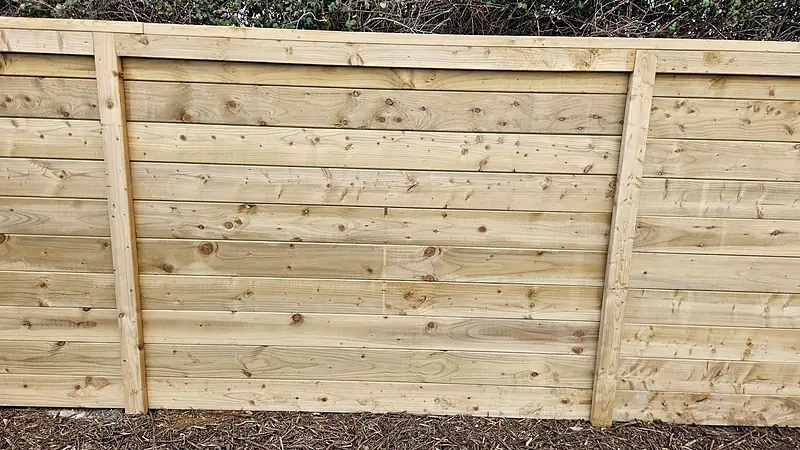
Get these right first.
Structural design
Post sizes, embedment and foundations come from the structural engineer's design. Our datasheets give indicative sizes and base reactions; ATF can arrange a site-specific design (chargeable).
Setting out and services
Locate buried services with CAT & Genny before digging. Set out the line, post centres, corners, gates and ends, and plan level bays on sloping ground.
Delivery and storage
Store boards flat on bearers, off the ground and under ventilated cover, in their bundles until needed. Plan phased deliveries on long runs.
Handling
Premium TGV boards come in 4.8m lengths of about 20kg each, so plan two-person handling. Eco boards weigh about 10kg each.
Tools
Post-hole auger or excavator, concrete, string line or laser, impact driver with Torx bits, saw, end-grain preservative, and a rubber mallet for Eco.
Safe working
Risk assessments and method statements for every job, with working at height and plant controls for tall barriers. Critical sites set their own rules.
Step by step, system by system.
NoiseBloc® Board & Batten
150×22mm close-butted boards with a cover strip over every joint, on 100×47mm rails.
- Set posts plumb at the specified centres in concrete to the engineer's design. On steel UB posts, bolt the 100×47 or 150×47mm timber packer to the flange.
- Fix the 150×47mm base board at ground level with no gap beneath.
- Fix the 100×47mm rails at a maximum of 600mm centres with 100mm Torx-head anti-vandal screws, with the top rail flush with the finished board height. Each 4.8m rail spans three posts.
- Nail the boards close butted with 50mm nails, lapping the base board by at least 50mm.
- Fix a 50×22mm cover strip centrally over every joint, then fit the 150×47mm capping.
- Treat any cut ends with end-grain preservative, then walk the line.
Standard details NB-BB-R-SD01 show every junction. The full Board & Batten installation guide is available from ATF.
NoiseBloc® Eco
225×45mm recycled plastic boards locked between galvanised steel UB posts (manufacturer's method).
- Set out the posts accurately, plumb and in line, at no more than the design centres (3.0m maximum), with fixing holes to the rear. Set them in concrete or base-plate them to the engineer's design.
- Apply the self-adhesive foam seal to clean, dry steel on the inner face of the front flange, about 10mm from the edge, one bay at a time just before the boards go in.
- Drop in the gravel board at the bottom of the bay and fit a locking H-section along its top edge.
- Build up the bay: place each board into the H-section, tap it home with a rubber mallet and fit the next H-section, until the bay reaches full height.
- Fit the packing beams behind the boards, knock them home and fix through the post with M5 Torx-head stainless steel anti-vandal fixings.
- Walk the line, checking the seal at every post, the base and each joint.
Packing beam and gravel board sizes and fixing lengths depend on the post size and are confirmed by ATF for each scheme. Standard details NB-ECO-SD01; full installation guide available from ATF.
Where barriers leak
Gates. Use NoiseBloc® matching gates, hung on posts sized for the gate. Keep the gap under the gate to a minimum, because gaps let sound through.
Ends and corners. Close the ends against buildings, walls or returns. A return corner also reduces the wind load on end posts.
Slopes. Step the barrier in level bays that follow the ground, keeping the bottom board or base board at ground level with no wedge-shaped gaps beneath.
Walk the line
- No gaps at the base, at board joints, at posts or at the ends.
- Tongues fully engaged (Premium TGV) and a cover strip over every joint (Board & Batten).
- Eco seals continuous at every post.
- Split or damaged boards replaced.
- Capping and counter rail secure; gates closing with a minimal gap.
- Photos taken for the client's or planning file.
Keep it gap-free
Inspect timber barriers once a year and after severe weather. Replace damaged or split boards promptly, keep vegetation and soil clear of the bottom board, and apply a breathable stain or paint only if a coloured finish is wanted. NoiseBloc® Eco needs no routine maintenance.
Downloads and support
Datasheets and CAD standard details for every system are on the downloads page. Our team can talk you through a first install, and approved installers get site support as standard.
Do I need specialist tools to install NoiseBloc®?
No. Standard fencing tools are enough: a post-hole auger or excavator, concrete, a string line or laser, an impact driver with Torx bits and a saw. Eco boards are tapped home with a rubber mallet.
How deep do the posts go?
Post embedment and concrete size come from the structural engineer's design. Our datasheets give indicative steel post sizes and base reactions to help with early design.
Can Premium TGV boards be fixed straight to steel posts?
No. On steel UB posts, a 100x47 or 150x47mm timber fixing plate is bolted to the flange and the boards are screwed to the plate, with a cover strip over the top.
How do I stop gaps under an acoustic fence on a slope?
Build in level bays that step with the ground and keep the bottom board or base board at ground level, so no wedge-shaped gaps open beneath the barrier.
Pricing a NoiseBloc® job?
Send the drawings or a site plan and we will return a budget price within 2 working days, with post sizes and a materials schedule.