

Acoustic barriers for padel courts and sports facilities
Padel is booming, and the sharp crack of the ball near homes is now one of the main reasons courts are refused or restricted. NoiseBloc® gives operators and court builders a tested barrier that helps get courts approved and keeps neighbours on side.
Or call 01264 366211, Monday to Friday
Why padel courts need acoustic barriers
Padel is played in a glass and mesh enclosure, and every shot off the solid racket makes a short, sharp crack. Those impulsive sounds stand out against the background far more than steady noise, and the glass walls reflect them out of the court.
Councils are increasingly refusing or restricting courts close to homes, and operators have faced complaints and enforcement after opening. Noise assessments usually look at the peaks of individual shots as well as the average level, and evening play makes the background quieter just when the courts are busiest.
A well-placed, continuous barrier between the courts and the nearest homes is often what makes the scheme acceptable, alongside sensible hours of use. Your acoustic consultant sets the height and line from the noise model.
What padel and sports projects need
- Tested data to model. DLR ratings and one-third octave band data for your consultant's assessment.
- Height where it counts. Fences from 1.98m to 7m as standard, on engineered steel posts.
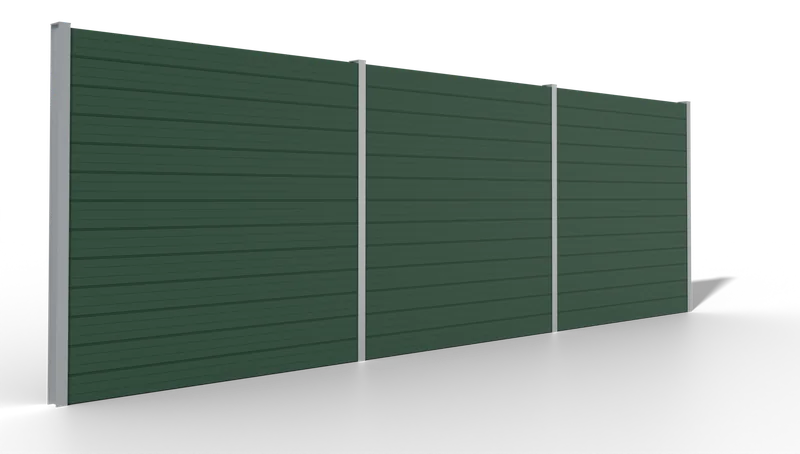
- An absorptive face. NoiseBloc® Eco absorptive (DLα 9dB*) reduces sound reflected back between the barrier and the court's glass walls.
- A finish that suits the setting. Timber for clubs and countryside sites and recycled plastic for low maintenance.
- No gaps. Continuous runs with matching gates, closed ends and no gap at ground level.
- Fit after complaints. Barriers can be added to existing courts where noise has become an issue.
*Manufacturer's data.
Which NoiseBloc® system for padel and sports sites?
Board & Batten (timber)
The value choice for club and leisure boundaries where the acoustic report asks for a solid barrier of 10kg/m² or 15kg/m².
Premium TGV (timber)
The higher timber rating (DLR 26dB road) and a clean, solid horizontal face that looks good from the courts and from neighbouring gardens.
Eco (recycled plastic)
Maintenance-free, with an absorptive face to reduce reflections between the barrier and the court enclosure.*
Not sure?
Send us the acoustic report or site plan and we will recommend a system, height and barrier line for your courts.
Settle these with the court builder early.
Barrier line
Close to the courts or close to the homes works best. Run the barrier past the ends of the courts so sound cannot escape around it.
Height
The barrier must block the line of sight from the playing area to upstairs windows, not just gardens. Your consultant sets the height.
Coordinate with the enclosure
Agree positions with the court builder so lighting columns, access, drainage and the court frame are not compromised.
Programme
Budget prices within 2 working days of receiving a site plan, so the barrier can go into the planning application.
Do padel courts need acoustic fencing?
Often, where courts are close to homes. Councils usually ask for a noise assessment, and a continuous acoustic barrier between the courts and the nearest homes is one of the most common ways to meet the limits, alongside controls on hours of use.
Which barrier is best for a padel court?
It depends on the setting and the level of reduction needed. Timber suits clubs and rural sites, Eco absorptive reduces reflections from the court's glass walls. Your consultant's report sets the minimum height and rating.
How high should an acoustic barrier for a padel court be?
The acoustic consultant sets the height from the noise model, so that the barrier blocks the line of sight from the courts to the nearest windows. NoiseBloc® fences are available from 1.98m to 7m as standard.
Can an acoustic barrier be added to existing courts?
Yes. Where courts are already open and neighbours have complained, a barrier can usually be added along the boundary or around the courts. Send us a site plan and the acoustic report and we will recommend a system.
Specifying or pricing a barrier?
Send us the acoustic report or drawings. We will come back with a system, heights and post sizes to suit, and an approved installer if you need one.